

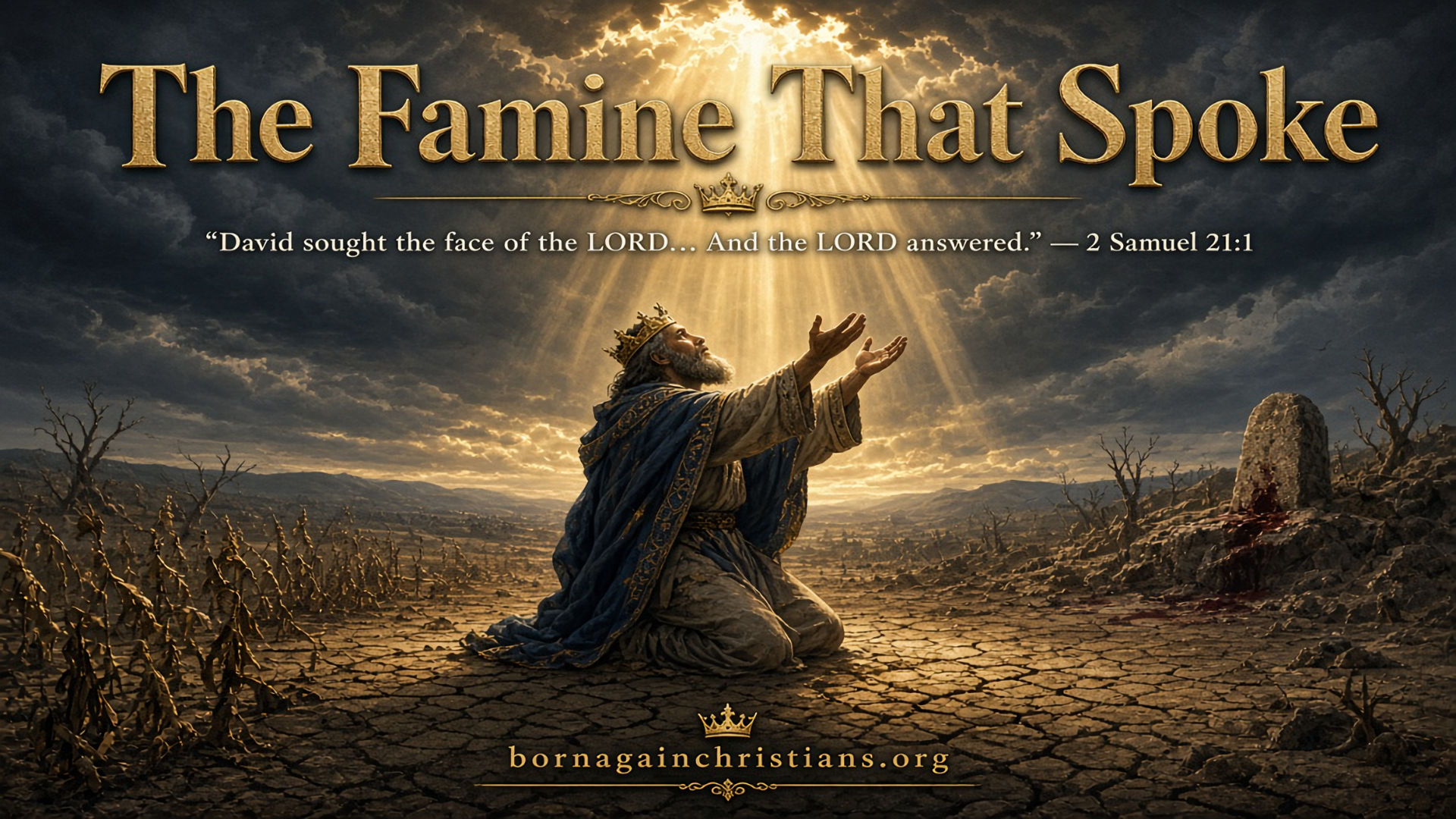
Well, let’s look at this passage in 2 Samuel 21. There was a famine in the days of David for three years, year after year. The land itself was hungry. The Hebrew word for famine is ra’ab. It’s the same word used when people are desperate for food. Year after year the crops failed, and the people felt it. After the third year, David did something wise. The text says he inquired of the Lord. In Hebrew it is stronger than a quick question: way-baqqesh David et-pene Yahweh — David sought the face of the LORD. He was not just asking for information. He was seeking God’s presence, His favour, His mind on the matter.
And the Lord answered plainly: “It is because of Saul and his bloodthirsty house, because he killed the Gibeonites.” The phrase is literally “the house of the bloods” — beit had-damim. Bloodguilt rested on the land because of what Saul had done.
A Covenant Made in Deception
Now this is interesting to me. To understand this, we have to go back more than four hundred years to Joshua 9. The Gibeonites were not Israelites. They were a remnant of the Amorites. When they heard what Joshua had done to Jericho and Ai, they came with worn-out clothes, patched sandals, and mouldy bread. They said they had come from a far country and wanted a covenant of peace.
The leaders of Israel looked at the evidence. They took some of the provisions. Then the Scripture says something sobering: they “did not ask counsel of the LORD” (Joshua 9:14). The Hebrew is et-pi Yahweh lo sha’alu — they did not inquire at the mouth of the LORD. They used their own judgment. They made a covenant and swore an oath by the name of the LORD.
God had told them not to make covenants with the people of the land. They disobeyed by making one, and they made it because they were deceived. Yet once the oath was sworn, God expected Israel to keep it. He takes our word seriously. Even a covenant made by mistake is still a covenant in His eyes. Years later, under Saul, that oath was broken. It is interesting to me how God expects us to honour the covenants that we make. People come to me for counsel and they have made a covenant of marriage, and they say, “Oh, it was a mistake. I never should’ve done it.” And they want to set aside the covenant. But once you make a covenant, mistake or not, God expects you to honour that covenant.
Saul’s Misplaced Zeal
Saul sought to kill the Gibeonites “in his zeal for the children of Israel and Judah.” The Hebrew word for zeal is qin’ah. It can be a good thing — a passionate commitment. But zeal without knowledge becomes destructive. Saul thought he was protecting Israel. In reality, he was breaking a solemn oath and bringing bloodguilt on the whole nation. The famine came decades after Saul’s death, but God had not forgotten. Time does not erase an oath made in His name.
David Seeks Atonement
Wwe see that David didn’t try to explain away the famine or blame it on the weather. He called the Gibeonites and asked, “What shall I do for you? And with what shall I make atonement, that you may bless the inheritance of the LORD?”
The word “atonement” here is kaphar. It means to cover, to purge, to make reconciliation. It is the same root used when Noah covered the ark with pitch, and it is the word behind the Day of Atonement. Bloodguilt needed covering. The Gibeonites did not want silver or gold. They asked for seven of Saul’s descendants to be handed over so justice could be done before the LORD at Gibeah. David spared Mephibosheth, Jonathan’s son, because of his own covenant with Jonathan. He honoured one oath while dealing with the broken one. After the matter was addressed, and after David finally gave Saul and Jonathan a proper burial, the LORD was entreated for the land. The famine ended.
Lessons That Still Speak
First, when trouble comes our way and keeps and coming year after year, seek the face of the Lord. Not every problem is spiritual, but also we should not close our eyes to the possibility that God is speaking through circumstances. We see David inquired, and God answered.
Second, God expects us to keep the covenants we make. Whether it is a marriage vow, a promise to a friend, or a commitment made in His name, He takes our word seriously. We cannot simply say, “That was a mistake,” and set it aside. Once the oath is made, He expects us to honour it.
Third, zeal must be according to knowledge. Passion for God or for His people is good, but if it leads us to break His Word or injure others, it is not from Him. Saul’s zeal brought a famine. Ours can do the same if it is not guided by Scripture and the Spirit.
Finally, there is a place for atonement. The bloodguilt on the land needed covering. In a far greater way, our own sin and broken promises needed covering. Jesus Christ is the perfect atonement. By His blood He covers our guilt, satisfies the justice of God, and opens the way for blessing again. What David could only partially accomplish by handing over seven men, Jesus accomplished fully by giving Himself.
If you are walking through a long season of hardship, do what David did. Seek the face of the Lord. Ask Him to show you if there is anything He wants you to face, any word you have not kept, any zeal that has gone astray. He is faithful. He remembers His covenants — both the ones we have broken and the everlasting covenant He has made with us in His Son.
May the Lord give you clear understanding as you study these things, in this article as you grow and become Bible-Strong.
Peter





Add comment