

Hair, Vows, and the Heart
Paul at Cenchrea and the women in Corinth
Acts 18:18 and 1 Corinthians 11:6 (NKJV)
Now look at this with me, looking at these verses for you Bible-strong folk; we read Paul stayed a good while in Corinth. Then he took leave of the brethren and sailed for Syria, and Priscilla and Aquila were with him. He had his hair cut off at Cenchrea, for he had taken a vow.
Then the same Paul writes back to that church: “For if a woman is not covered, let her also be shorn. But if it is shameful for a woman to be shorn or shaved, let her be covered.”
Same man. Same kind of haircut. Two different pictures. That is why we need to open the Book and let the Spirit teach us.
-
What happened at Cenchrea?
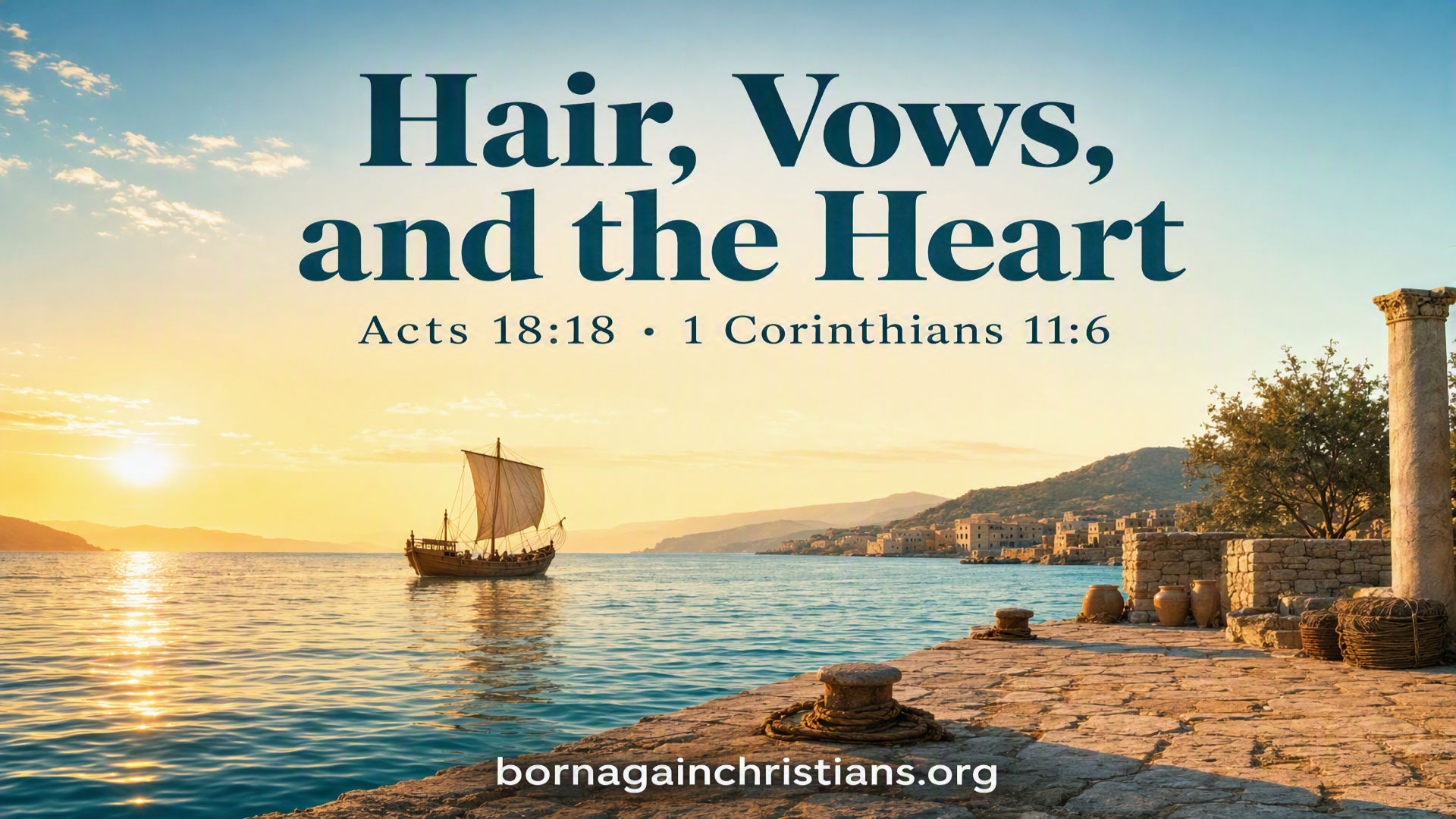
Cenchrea was the harbour on the east side of Corinth. Paul is leaving after a long, fruitful time. Luke just drops this little note in: he had his hair cut off because he had a vow.
Greek help (Acts 18:18)
- keiramenos (G2751) — he sheared his hair. You will meet that same verb in 1 Corinthians 11.
- kephalēn (G2776) — head. Paul uses that word for the head on your shoulders and for the one who has authority.
- euchēn (G2171) — a vow. A solemn promise to God. You see it again in Acts 21:23. James uses the same word for prayer.
Luke does not spell out the vow. Most of us who have walked through the Word see here the end of a Nazirite-type vow. Paul finished what he told the Lord he would do.
-
The Nazirite vow in Hebrew
Numbers 6:2 says, “When either a man or woman consecrates an offering to take the vow of a Nazirite, to separate himself to the LORD.”
Hebrew help
- neder (H5088) — a vow, a promise made to God.
- nazir (H5139) — one set apart, consecrated.
- lehazir — to separate yourself unto the Lord.
Now get this. It was voluntary. It was for a man or a woman. It was not a priestly office. It did not belong to Levi only. A Benjamite like Paul could take it. No problem.
You did not drink wine. You did not put a razor to your head while the days lasted. You stayed away from the dead. When the time was up, you cut the hair. If you could, you took it to the temple.
The Bible only names a few — Samson, Samuel, John in that same spirit, Paul, and those four men in Acts 21. But Amos 2 says God raised up Nazirites among the people. Most of them never got their names written down. It was never the way you got saved. It was a heart that said, “Lord, for this season I am Yours.”
-
Why would Paul do this?
Paul says he was “of the tribe of Benjamin, a Hebrew of the Hebrews.” After he met Jesus he did not throw every Jewish form in the trash. He was already saved by grace. The vow did not add one thing to the cross.
Sometimes he became as a Jew to the Jews that he might win them. Sometimes it was just a man saying thank You to God. Luke does not give us the reason. He only tells us Paul kept his word.
He was free to do it. He was free not to do it. That is the grace of God, beloved.
-
Then why the strong words to the women?
Paul writes, “Every woman who prays or prophesies with her head uncovered dishonors her head… For if a woman is not covered, let her also be shorn. But if it is shameful for a woman to be shorn or shaved, let her be covered.”
Greek help
- akatakalyptō (G177) — uncovered.
- kephalē (G2776) — head again, the physical head and her head in authority.
- keirō (G2751) — same “shear” word used of Paul.
- xuraō (G3587) — shaved with a razor.
You see the difference? At Cenchrea a man’s cut hair could mean, “I have finished my vow.” In Corinth a woman’s shorn or shaved head often meant shame. That city was full of temple prostitutes coming down from Aphrodite’s hill. An uncovered or shaved woman sent a message Paul did not want in the gathering of the saints.
He is not saying hair is sinful. He is saying, do not throw off the sign that in your town marks honour and the order God made.
And notice — the women were praying and prophesying. He does not tell them to sit down and be quiet here. He tells them to do it in a way that honours their head.
Underneath the custom is creation. “The head of every man is Christ, the head of woman is man, and the head of Christ is God.” God made them different on purpose. Liberty in Christ does not rub that out.
-
Hats, caps, and a judging spirit
A lot of older churches, the Free Church of Scotland among them, took this into their own culture. The ladies wore a hat. The men took the cap off. That was their sign.
Wanting to honour the Word is good but you know and I have seen this as the trouble starts when the sign becomes the test. Then we watch hats more than we watch Jesus. Custom can serve the gospel. Custom can also become a yoke around the neck.
Paul said, “Stand fast therefore in the liberty by which Christ has made us free, and do not be entangled again with a yoke of bondage.”
I have said it for years: teach the whole counsel of God, then leave the people in the hands of the Holy Spirit. You and I are not the Holy Spirit for somebody else.
-
What about a 30-day Nazirite vow today?
If the Lord is stirring you to set a season apart, that is a beautiful thing. I like that.
But do not put yourself back under Numbers 6 as if you were still under Moses. “You are not under law but under grace.” Those ceremonies pointed to Jesus. He has come. The work is finished.
Set the days apart the New Covenant way. More time in the Word. More time in prayer. Lay down whatever is pulling your heart from Him. Write down what He shows you.
Call it consecration if you want. Do not call it a way to get more saved. The blood of Jesus already brought you near.
-
The big idea
Paul’s shaved head at Cenchrea was a Jewish believer finishing a vow in the liberty of grace.
A woman’s uncovered or shaved head in Corinth risked shame and a blurring of what God designed.
Same Greek verb. Different person, different place, different purpose.
We are not saved by a vow. We are not saved by a hat. We are saved by Jesus. Then we walk with Him in freedom and in order. We do not hang yokes on each other. We open the Book. We trust the Spirit. And we keep a heart that says, “Lord, I am Yours.”
For the reader
- Open Acts 18:18 and 1 Corinthians 11:2–16 in the NKJV. Use Blue Letter Bible and click the Hebrew and Greek.
- Ask the Lord if He wants a simple season of extra prayer and Word — not to earn anything, just to love Him.
- If you have judged a saint over a hat or a custom, take it to the cross.
- If you have used “liberty” to ignore the order God wrote into creation, take that to the cross too.
- Teach the Word. Then leave the people with the Holy Spirit.
The Word of God is living and powerful. And the Holy Spirit still knows how to take that Word and do the work in a human heart.

















Add comment