

A simple look at the trades in Acts — and at 1 Corinthians 3:10
Now I want you to look with me at something very practical in the book of Acts. We meet two ordinary working men. One is Simon the tanner in Joppa. The other is Paul the tentmaker in Corinth. Some folk put those two jobs together as if they were the same thing. They were not. The Greek makes that plain. And then, if you follow it through, you come to a beautiful picture in 1 Corinthians 3. The Lord Jesus, who worked with His hands, became the Master Builder of the church.
Simon the tanner
Acts 9:43 (NKJV) says, “So it was that he stayed many days in Joppa with Simon, a tanner.” You find the same word again in Acts 10:6 and 10:32.
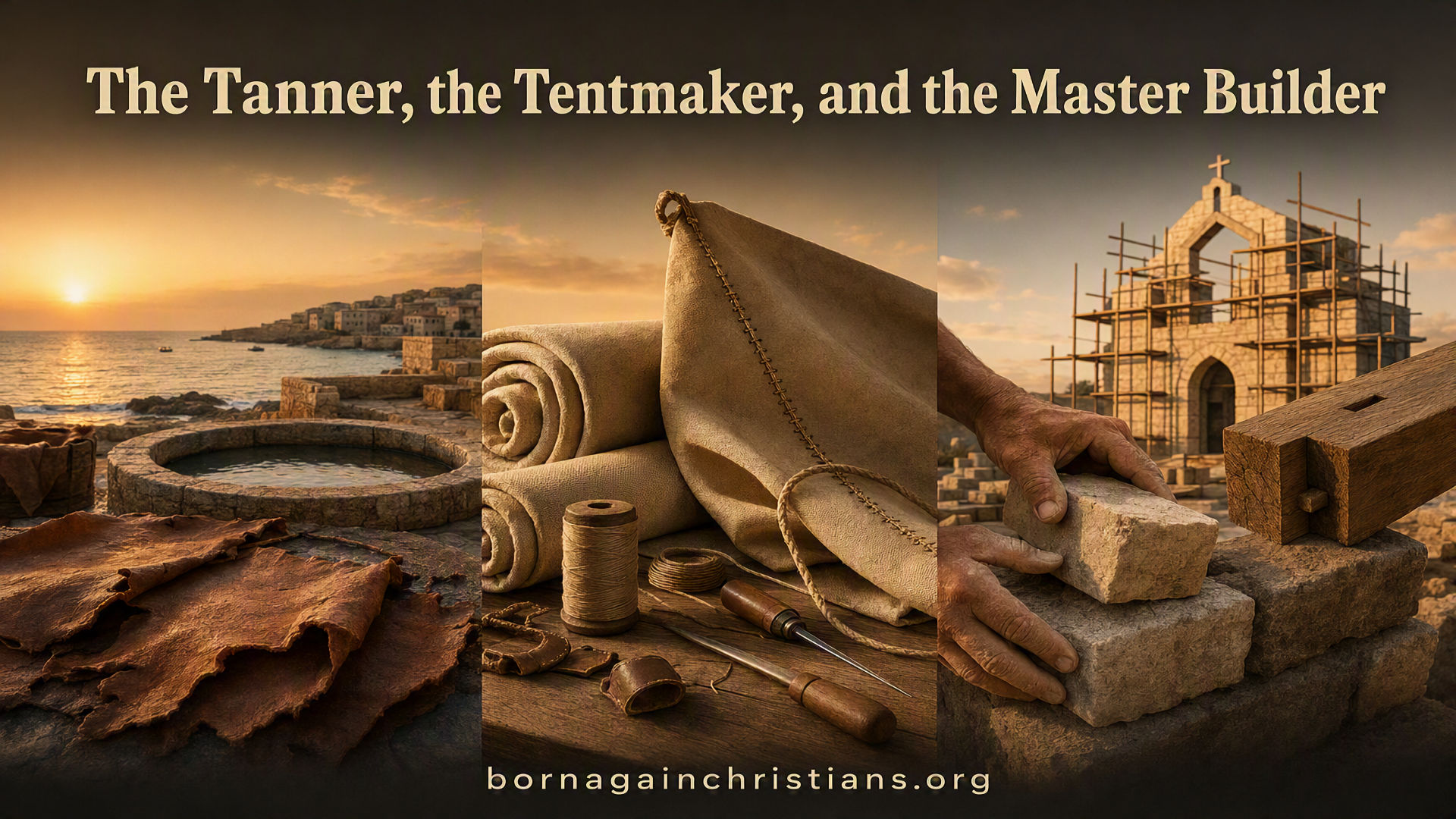
The Greek is burseus. It comes from a word for a hide. Simon’s work was taking raw animal skins and turning them into leather. It was a dirty job. It smelled. Many of the Jews counted it unclean because you were handling dead animals all day. That is why his house was “by the sea.” The smell could blow out over the water.
And yet the Lord used that house. Peter was staying there when he received the vision that opened the door of the gospel to the Gentiles. Isn’t that just like the Lord? He is not ashamed of the man nobody else wanted to sit with.
Paul the tentmaker
Now turn over to Acts 18:3 (NKJV): “So, because he was of the same trade, he stayed with them and worked; for by occupation they were tentmakers.”
Here the Greek is different. It is skēnopoioi — tent-makers. Two words: skēnē, a tent, and poieō, to make. Paul, Aquila and Priscilla cut and sewed the material into finished tents. In Cilicia, where Paul grew up, they used a rough goat-hair cloth they called cilicium. Some tents were leather. But the job itself was making the tent, not tanning the hide.
So one man prepared the leather. The other men made the tents. Two different words. Two different trades. Paul used that trade so he would not be a burden on the new churches. He says so in Acts 20:34 and in 1 Thessalonians 2:9. He worked with his own hands.
Why young rabbis learned a trade
It was the custom in Israel that a father taught his son a useful trade as well as the Law. The rabbis said it strongly: if you do not teach your son a trade, it is as if you taught him robbery. A scholar was not to live off other people.
It is not unlike a lad here in Scotland learning a trade before he ever thinks of university. The trade comes first. The higher studies come after, if the Lord opens the door.
You see it in the New Testament. Jesus and Joseph were called tektōn — a craftsman, a builder (Mark 6:3; Matthew 13:55). Paul was a tentmaker. Hillel, the grandfather of Gamaliel who taught Paul (Acts 22:3), is remembered as a woodcutter. He worked by day and studied by night.
The Lord does not despise honest work. He used it.
Was Jesus a carpenter or a stone mason?
People argue about that. Let’s just look at the word.
The Greek in Mark 6:3 is tektōn. It does not mean “wood-worker only.” It means a skilled craftsman who works with hard materials — wood, stone, or metal. In Nazareth the houses were mostly stone. Wood was used for roofs, doors, beams, ploughs and yokes.
The earliest note we have outside the Bible is from Justin Martyr, about A.D. 150. He says Jesus made ploughs and yokes. Those are wooden tools. So the old picture of Him at a carpenter’s bench is very early. The fairest way to say it is this: He was a builder-craftsman. He worked with whatever the job required.
The Lord of glory spent those quiet years shaping stone and timber with His own hands.
Then He became the Master Builder
And that is where 1 Corinthians 3:10 becomes so precious.
“According to the grace of God which was given to me, as a wise master builder I have laid the foundation, and another builds on it. But let each one take heed how he builds on it. For no other foundation can anyone lay than that which is laid, which is Jesus Christ.” (1 Corinthians 3:10–11, NKJV)
Do you see it, this was what I was wanting to get at? The One who learned to cut a true line in Nazareth later said, “I will build My church” (Matthew 16:18). Paul then took his place as a workman on that same building. The foundation is not Paul. The foundation is Christ.
The trades we read in Acts are not little side notes , but they show us the kind of Lord we serve. He used a tanner’s house. He used a tentmaker’s bench. He used a carpenter’s hands. Then He built something that will never fall.
A closing thought
God does not despise ordinary work. He used it. He still uses it. Whether you work with hides, canvas, stone, or a keyboard, you can do it unto the Lord. And He may use that very place to further His gospel.
No other foundation can anyone lay than that which is laid, which is Jesus Christ.



















Add comment